
Introduction
Johari Window is developed by American psychologists Joseph Luft and Harry Ingham in 1955. The name ‘Johari’ came from joining their first two names. This model is also represented as a feedback/disclosure model of self-awareness. The ‘Johari’ window model is a convenient method used to accomplish this job of understanding and improving communication between the members in a group.
This model is based on revealing information about yourself to others on two ideas- trust and learning yourselves through their feedbacks. Each person is represented by the Johari model through four window panes.
The Johari Window

Each four window panes indicates personal information, feelings, motivation and whether that information is known or unknown to oneself or others in four viewpoints.
Public Self: What you have known about yourself as well as by others.
Blind Self: Information that others know about yourself but you are unaware of it. Others may understand yourselves differently than what you expected.
Private Self: Information that you know but is being kept unknown to others. This can be any personal information which you feel reluctant or unwilling to show.
Unknown Self: Information that you are not aware of yourself as well as to others.
Analysis 1:
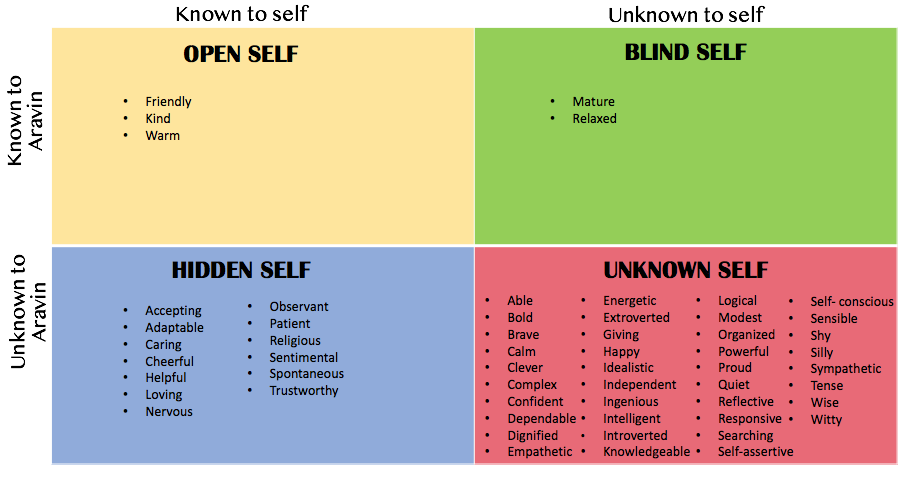
First of all, the Johari Window analysis done by one of my classmate/new friend, Aravin, which I know less than a month, to choose out of the 56 adjectives he feels applies to me.
Based on the result shown above, I feel that the result is not an accurate presentation of myself. The analysis of Aravin is based on a few conversations we had. I am quite surprised at Aravin’s analysis as Aravin feels that I am mature which in actual, I am not quite mature and also Aravin feels that I am a relaxed person but I feel that I am not quite a relaxed person as sometimes I tend to be quite tense. But there are still a few that Aravin and I both know is that I am friendly, kind and warm.

This result will be useful as Aravin and I will be working together in a group for a project. It provides me with information about relationships with others and gives me the opportunity to improve myself. Not only that, but it can also help us to build better, more trusting relationships with one another, solve issues, and work more effectively as a team.
Analysis 2:
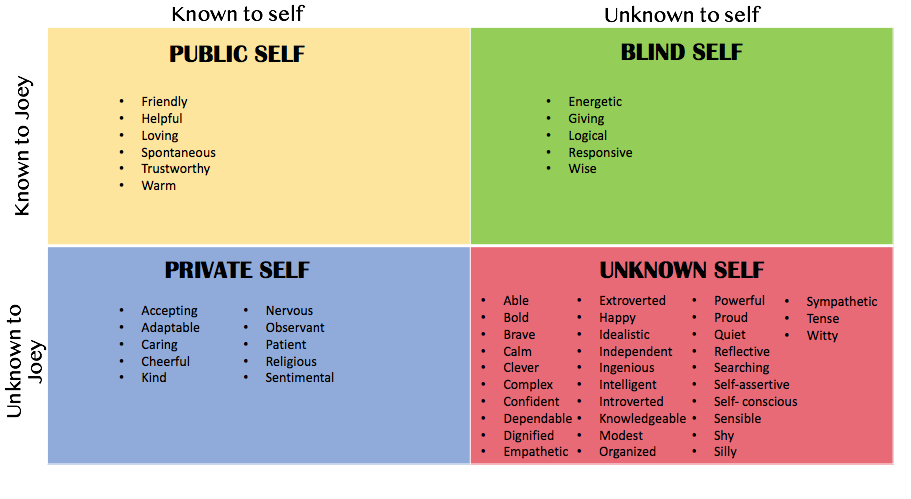
The Johari Window analysis is done by one of my childhood friend, Joey, which I know for many years, to choose out of the 56 adjectives he feels applies to me.
Based on the result shown above, I feel that the result is more accurate as compared to Aravin’s result. To a friend who you have known for a long time still knows you better as compared to a new friend who you have known for less than a month. You tend to be more open up to a friend who you known for long as compared to friend you only know for less than a month.

But I am still quite surprised that some of the adjectives that Joey describe me as, for example, energetic, giving, logical, responsive and wise, is something that I am not aware of myself. But, of course, there is something that she is not aware of me too.
This result will be useful as my childhood friend, Joey, provides me information that I did not aware of myself. It helps us to further improve our relationships with one another and work more effectively if we are working as a team in future.

 Xinhui’s blog
Hey Xin Hui,
Great explanation of the 4 areas of the Johari model. I do agree that the Johari model’s analysis is useful, especially when we are working with other people in projects. Through the model, it can allow us to better understand ourselves and our teammates, where we can improve ourselves from there. This would hence improve the effectiveness in working together as a team.
I do agree that the model’s analysis would be different from different people (E.g. someone you just knew compared to someone that you have learnt for a long time). We would display different sides to ourselves to different types of people (E.g. friends, classmates, colleagues), and through the model, we would be able to learn new areas that others perceive of us.
LikeLiked by 1 person
Hi Xin Hui! Excellent and informative post on Johari Window. Johari Window gives us a better understanding of ourselves and our relationships with others. I agree with you that the Johari Window is more accurate when done with someone who has known you for years than with someone who has known you for a few weeks. This is due to the fact that someone who has known you for years would know more about your personality while someone who has known you for a few weeks can only guess your personality based on initial impressions. I had similar results to you when I did the Johari Window. Looking forward to your next blog!!!
LikeLiked by 1 person
Hello Xin Hui! Your clear explanation makes it easy for people that are new to the Johari Window to understand. I do agree with you that it is a convenient method to use to provide understanding and improvng communication between members in a group. I also agree with you that the model allows us to see ourselves better, identifying our “hidden” traits that we do not know or traits we need to work on. Love how you did the Johari Window with your fellow project mate as he could now have a better understanding of you and might be able to understand your work style. Looking forward to see your next post!
LikeLiked by 1 person
Hi, Xinhui~Enjoyed reading your post about the Jahori Window, and also I came to know more about you no matter it’s the one presented publicly or hidden inside. Through your explanation and analysis of Jahori Window, I came to realise that everyone really has some sides that even close friends cannot see, but of course, compared with friends only known for weeks, close friends still know better and can describe more accurately about the personality. And what I have to mention is that I really like the Jahori Window graph that you made coz it is just so clear and understandable. Look forward to seeing your next post!
LikeLiked by 1 person
Hi Xinhui,
At first glance, your post looks very clean and organized and I was surprised that it wasn’t one of the adjectives in the open area. I like how you add the explanation to the difference in results which shows us that time spent together is a critical factor in the Johari Window. I also like that you have chosen Aravin as he would be your team member for a project. By using the Johari window in a practical environment, it shows us how the Johari Window can help us improve relationships.
LikeLike